

Growing Up DWP
An Argument for Municipality vs. Profit Sharing

Tl;dr at the end for the impatient or don’t want to read 14 pages of information.

It was a hot day. Running around in the city of San Fernando, CA. We, me and the local kids, played baseball, football and whatever else we can do to keep ourselves busy. In those days, I would spend months looking at the mountains full of snow and enjoy the golden brown my skin would turn when it was Summer. It’s good to think about those feelings and smells sometimes.
You know what else I remember? We never had rolling black outs. We had hot days. 100° - 110° but there was no rolling black outs.
You know, when the Northridge Earthquake hit, I watched as transformers blew up, there were bridges falling and it was a calamity. After the earthquake, the freeway shutdown, of course, because it had fallen and architects and builders learned from that. They learned that we need to be more earthquake ready so they informed everyone about how to prepare.
There were no black outs. As a matter of fact DWP has 99% of all customers restored withing 24 - 48 hours.
I’ve seen people add solar and get paid for selling their power and I’ve seen that change over time to make sure everyone pays something. But, never rolling black out.
You see, the LADWP began with water services in 1902 and began adding electricity to their service around 1917. According to their website and sources I can find, they have “…continually evolved to meet the needs of our customers and provide reliable water and power service in a cost-effective and environmentally responsible manner.”
In looking at their record, they have one fire attributed to them due to failure of equipment maintenance. Their bottom line is service + infrastructure stability. LADWP is financed with tax-exempt municipal bonds.
Now, let’s talk about Southern California Edison. Going back to my before days I remember the first time the news scared me. It was the year 2000 and they said it’s hot, we were going to have rolling black outs. I was a little worried but, they never came. We had zero rolling black outs.
Let’s fast forward to 2025, when I moved to Altadena in 2020, and here we are. Under Southern California Edison. So, let’s learn about them.
Southern California Edison was formally incorporated in 1909 and born out of many smaller electricity companies. The parent company, Edison International is publicaly traded in the market as EIX.
According to verifiable records, Southern California Edison reported over one hundred equipment related ignition events per year. California’s Investor-owned utilities (IOU) have the highest rate for utility caused wildfires in the United States. Southern California Edison has been implicated in the Thomas Fire (2017), Woolsey Fire (2018), Bobcat Fire (2020), Fairview Fire (2022), Hemet Fire (2022), Eaton Fire (2025).
In order to pay for the damages their equipment allegedly causes, they tap into the California Wildfire Fund created in 2019 which is funded by…
Ratepayers and shareholders! But mostly ratepayers…
This is a 50/50 system that favors the shareholders, where the ratepayer have to pay on each bill. All while the shareholders pay in installments, spaced out over years and require the California Public Utility Commission (CPUC) wildfire safety certification, IOU creditworthiness thresholds, and annual regulatory approval.
This causes ratepayers to fund their $10.5 billion share and the additional wildfire-related rate hikes unrelated to the fund. The initial $10.5 billion contribution came from the taxpayers of California.
Let’s talk about Municipal Power and what it looks like.
A quick search defines Municipal Power as electricity generated, distributed, and supplied by a local government entity to its community.
“Municipal electric systems are held to public accountability standards. Public records, open meetings, competitive bidding, public budget hearings and prevailing wage laws are just a few of the public accountability standards unique to most municipal electric suppliers,” according to amppartners.org.
Cool. Since Municipal Power are publicly funded, any revenues go back into the local government as a reinvestment to infrastructure. The guys that came and fixed all of the power issues after the Northridge Earthquake went in like a team and made the things happen. There is this sense of service to the people, from what I gather.
Let’s define Investor-owned utilities (IOU). A quick search finds that the definition is for-profit, privately held companies that provide public services like electricity, natural gas, or water to consumers in a specific geographic region.
What that means is that when they get revenues, it doesn’t get reinvested into infrastructure completely, it goes into the pockets of the shareholders.
This matters!
In 2000 - 2001 - the energy crisis = rolling black outs for Southern California Edison customers, you can take a good guess at who those customers were. ah hum. Good old Enron was unable to manipulate LADWP because they aren’t an Investor-owned utility.
You see, during those black outs, there was a specific policy in place of who to protect:
Hospitals
Media/communications
Government
High-value commercial districts
Areas with political or economic influence.
So, you if you guessed lower socioeconomic, you guessed correctly. This means poor people. - you can find this information in the CPUC operational reports, FERC post-crisis analysis and investigation journalism from 2001 - 2003.
Now, let’s take a trip to Unincorporated Altadena. What does that mean exactly? It means that Altadena is governed by Supervisor Kathryn Barger. She is responsible for making decisions for the area and will listen to the opinions of the Altadena Town Council. Altadena has no independent power to negotiate contracts for any services. The county cannot direct Southern California Edison operations because utility regulations are CPUC’s direct jurisdiction.
The Los Angeles County Board of Supervisors governs 10 million people and Altadena is a tiny fraction of those people. On average, each county supervisor represents about 2 million residents. So, as you can imagine, it’s easy for Altadena to be overlooked by any one of them. However, Altadena has only one, Kathryn Barger. Report after report after report, there are systematic failures across the board. Delayed evacuations, poor wildfire communication, inconsistent alert protocols across unincorporated areas, lack of investment in fire-prone foothills, and chronic emergency services understaffing.
What are the qualifications for becoming a supervisor?
Core qualifications
Constituent status: Must be a constituent of the district you are running in.
Residency: Must have resided in the district for at least one year immediately preceding election.
Election: Must be elected by the voters of that district.
Supporting and desirable qualifications
Community involvement: A track record of community involvement is crucial.
District-specific knowledge: Understanding the specific needs and issues of the community you want to represent is important.
Professional experience: Professional experience in relevant fields like public administration, public policy, or law is highly beneficial.
Problem-solving skills: The ability to work with a wide range of stakeholders and solve complex issues is a key skill.
Communication skills: Strong written and oral communication skills, including public speaking, are necessary to engage with constituents and present information effectively.
Experience in local government: Familiarity with local government operations and community engagement is a strong asset.
Since the qualifications to become a supervisor does not include expertise in emergency response and utilities, they rely on others to help them out. Those others are the CPUC, contractors, and… you guessed, Southern California Edison. The Board can’t do anything about the electrical infrastructure within the communities they are literally in charge of. Therein seems to lie the problem, isn’t it.
Utility regulation is exclusively a CPUC function. County supervisors cannot order SCE to upgrade equipment or change operations, but they are responsible for local emergency readiness, communication, evacuation protocols, and oversight of county agencies.
As of now, all Altadenans know who is at fault for the tremendous destruction that was laid upon Altadena. Altadena knows how it happened. Altadena has seen the videos, has heard the stories. Altadenans have grieved together for over 10 months now.
On the table right now is a proposal from Southern California Edison to give money to those who will sign up for it. Some will and then they will lose the ability to sue. While doing this, they not only have tapped into the Fire Relief Fund (paid for by ratepayers, mostly) but they have now raised the rates on those customers within their service areas. It’s like a magic trick, right?
So, let’s look at rates, shall we…
Data as of 2025, LADWP has three tiers.
Tier 1 (low use): ~22 cents/kWh
Tier2 (moderate use): ~28.6 cents/kWh
Time Of Use (TOU) option: Rates vary by time of day and season
A typical residential monthly bill is about $120 (545 kWh)
As of October 1, 2025, SCE residential rates are:
35.3 cents/kWh or 33.3 with climate credit.
A typical residential bill is about $193 (500 kWh)
Historical Rates (Past ~10 years)
(We will discuss Solar later)
Rates over 10 years
LADWP 2015-2020
Residential rates (Tier 1) were about 19 - 22 cents/kWH for Tier 1 for most of the decade. They specifically under invested in capital projects for years and kept rates low but created a future need for upgrades.
LADWP 2020-2022
Rates increased modestly with Tier 2 being ~24 - ~26 cent/kWH which was a response to renewable energy mandates, transmission upgrades, and inflation.
LADWP 2023-2025
Catching up on their delayed infrastructure, rates hiked a bit.
Tier 1: ~22.8 cents/kWh
Tier 2: 28.6 cents/kWh
Tier 3: 37 cents/kWh
Overall trend has been slow increases over a decade with municipal financing and no shareholder profit. Community over profit.
SCE 2015
Average rate ~19-21 cents/kWh
SCE 2016-2019
Rates increasing steadily to deal with wildfire mitigation spending, grid modernization, CPUC-approved cost recovery ~24-27 cents/kWh.
SCE 2020-2022
By 2022, average rates increased to ~29-31 cents/kWh in response to massive wildfire-related liabilities. The rates climbed quickly with an about 2-3 cent increase per year.
SCE 2023-2024
A typical residential rate reached ~33.2 cents/kWh in 2024 due to SCE rate cases seeking billions in recovery for the wildfire costs.
SCE 2025
One of the most steepest rate increases to 35.3 cents/kWh on average.
Climate credit factored in - 33.3 cents/kWh
Side by Side Comparison
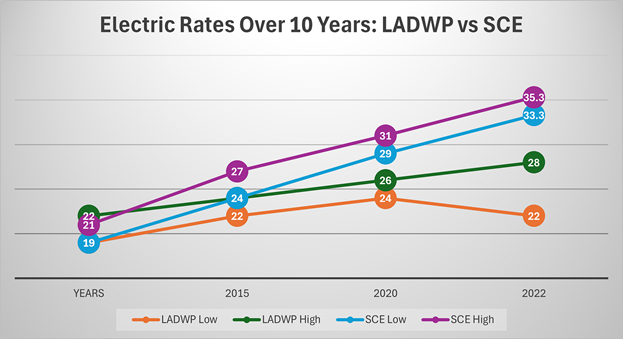
Overall, Altadena households are paying ~60 - 60 more dollars a month for less energy.
What about Solar?
First you need to understand NEM which is Net Energy Metering. This is the rule that determines how much money a homeowner gets paid for excess electricity produced by their solar panels and sent back to the grid.
I one took a deep dive into solar and found that if a whole city of houses were to get on solar, you could almost have a city where the residents wouldn’t have to pay for electricity and the utility could sell the electricity back to whoever needed it, especially bigger buildings. It was a deep dive for sure.
There are three major versions of NEM - 1.0, 2.0, 3.0.
NEM 1.0 & 2.0 means you were paid full retail prices for what you sent back into the grid. A good example would be, if you pay 30 cents/kWh, whatever overage you had and sent back into the grid would earn you 30 cents/kWh.
NEM 3.0 means you are paid for costs that the utility didn’t have to spend on infrastructure for you to have solar. So, for the same example of 30 cents/kWh as above, you would sell your energy back to the grid and earn about 2-6 cents/kWh.
NEM 3.0 was approved by the CPUC in 2022 and implemented in 2023 to drastically changed the value of exports, extend the payback period, and change the financial viability of rooftop solar in the areas covered by IOUs.
Southern California Edison , along with other IOUs, claimed that this changed needed to happen because solar was inadvertently causing non-solar customers bills to skyrocket. Their big claim was that solar customers weren’t paying enough towards the grid.
What about LADWP?
LADWP is not affected by NEM 3.0. They are a municipality and therefore shielded by this rule.
LADWP uses a standard NEM where excess solar energy is credited at a retail rate. There is no cap on NEM aside from the size limit of your system which has to be ≤ 1 MW AC for rooftop systems. Also, if you push excess into the system, the rollover, month-to-month.
They offer an incentive program (SIP) and zero upfront lease program (SRP). I’m not saying they are the best programs, but they have them.
What does this mean?
Well, it means that the payback of the of LADWP gets reinvested into infrastructure. Into the local community.
California Mountains and Fire Reality
Years ago, when I was in college, I had to take an elective. So, I took Geography with a special lesson in California Mountain Ranges and the Geography of our great state.
California’s Mediterranean climate is one of only five on Earth. California is, at its worst a desert, and at most, a sky resort. We have a vast geographical system from water to mountaintop that inhabits a variety of plants and animals that depend on nature taking its course. Nature, at the end of the day, will nature. Wet winters followed by long, dry, hot summers and the inevitable fire season. Somewhere between all of this, the Santa Ana winds come in.
Why is fire season inevitable?
It is really important to understand the reality here.
California mountains are filled with Fire Plants. You can see them as you are walking along the paths. There’s Coastal Sage Scrub, Chaparral, Yucca & other cactus species. Then there’s the fire plants that love the fire and aggressively sprout afterwards like Chamise, Manzanita, Ceanothus, and the Sage Scrub.
Some fire plants are fire-adapted while others are fire-dependent. Fire-adapted plants survive fires, while fire-dependent plants require fire to reproduce.
The indigenous nations of Tongva, Chumash, Tataviam, and others would use fires for their cultural burnings to reduce fuel buildup, encourage new growth, create mountain trails, support deer and small game habitat, and protect the villages. They were low to moderate in intensity and frequent, which in turn prevented large fire catastrophes.
In the 1850s, the state outlawed these cultural burnings and fuel accumulated for over 150 years and this is how we operate today.
1910 - 2000 created the full blown “full suppression” idea for modern California where the key ingredients were, put out every fire and do it as quickly as possible. As you can imagine, this allowed old trees and plants to become dense brush, chaparral exploded and unnatural fuel loads helped any fire become hotter, faster, and more destructive.
The end of the natural cycle of fires every 20-30 years has pushed some foothills to cycle every 80-120 years. And then BOOM! and explosion of fires.
Scientifically, the San Gabriel Mountains are among one of the most fire-prone ranges on Earth with steep canyons to funnel wind downward with plentiful vegetation to burn.
The Santa Ana Winds
The Santa Ana winds dry out vegetation quickly so when there is a fire, the winds do their job of pushing the fire onwards, towards its ancestral burn path. They originate from high-pressure systems over the Great Basin (Nevada, Utah) and bring cold, dense air sinks from the high desert. Gravity then kicks in and pulls the winds down towards the coast. As the air passes through the mountains and canyons, it compresses and when that happens, they heat up by about 20-40 degrees. That’s why they feel so hot and dry by the time they reach Los Angeles.
The danger behind these winds is that they drop humidity to single digits. So, if you are already having a dry season, and the vegetation is dry, well, the Santa Anas are happy to come through and clear that brush that’s on fire for you.
Since the indigenous people understood their patterns, they’d burn during safer seasons to reduce the risk of catastrophe. These winds typically peak from September through March.
Governor Newsom Isn’t Part of The Altadena Story
Clarity. Altadena is governed locally by the Los Angeles County of Supervisors = Kathryn Barger. The Governor of California is not directly responsible for the governance or utility oversight failures that directly affect unincorporated areas.
Altadena does not have a city council.
Altadena does not have a mayor.
Altadena does not control its own police, fire, zoning, or utility contracts.
Governance falls squarely on the lap of County Supervisor Kathryn Barger. She was appointed by the people who voted for her.
Governor Newsom appoints CPUC commissioners but
CPUC commissioners serve fixed terms
CPUC operates as an independent regulatory entity
CPUC approves IOU rate cases, wildfire mitigation plans, penalties, and NEM rules
Not the Governor’s Office.
Emergency management during wildfire follows this path:
Local Fire → Sheriff → County Office of Emergency Management (OEM) → Calfire → State Office of Emergency Services (OES) → FEMA (if needed)
The failures happen at the county level → Kathryn Barger.
So, What Does It All Mean?
Look at the full picture. It’s time to really take a look at the climate and geographical areas we all live in, and understand what we can expect from the future. Cities that sit within fire-prone mountain ranges in the world are headed in the direction of extreme heat, drought cycles, winds, and fires. Our California geography demands strong infrastructure, fast and actual maintenance, and a utility that is structured towards public safety.
A million years ago, it was decided that Southern California Edison would be in charge of certain areas where humans reside. That no longer seems like a safe bet, in any area. Investor-owned utilities only seem to care about one thing, and that is not the people who are paying them. Their obligation is to their shareholders.
Municipalities show us that they are reliable and care about the ratepayer. The proof is in the records.
Since Altadena has no city government, no mayor and no independent utility contract, there is no direct control over decisions that affect the safety of the people. Governance flows through the County. The grid flows through Southern California Edison. This disconnect is where we can find the larger failure.
The fire that overtook Altadena wasn’t “nature doing what nature does”. Nope. It was the product of a system that allows critical equipment to age, become frayed and dangerous and a conduit for massive fires. Now, residents are not only expected to pay higher rates to make up for their failures but are offered an alarmingly disrespectful compensation package? Crazy.
The path to municipality is long and hard, but I think there is a good argument to say, we need municipality.
It’s time to put humans first.
For-profit utilities and high risk fire zones do not mix well. They put investors first and we need the people to be put first.
Aren’t you tired of profits before people yet? Check out The Path to Public Power.
The Path to Public Power
So, there are some options here, right? One is to incorporate… boo. I said some options so there are a couple of other ideas.
Form a Community Services District (CSD)
which could legally:
Own and operate public utility
Buy wholesale electricity
Build or maintain distribution lines
Set local utility policies
Contract with municipal utilities like PWP, LADWP, Burbank, Glendale, etc
Governing body is added only for services that the community wants to control.
Government Code §61100
This would be the cleanest way, especially if one of the companies are willing to come service.
Create a County Service Area (CSA)
which would keep the city as is and still under Los Angeles County.
It would be controlled by LA County
Be funded by the city
Could negotiate separate utility contracts
However, Kathryn Barger would still be in control and the residents would have little to say on any matter.
A Joint Powers Authority (JPA) with another city
An unincorporated area forms a CSD OR
LA County represents the city via a CSA
The public entity signs a Joint Powers Agreement with a neighboring incorporated city.
For Altadena and Pasadena, it would look something like Altadena-Pasadena Public Power Authority
The JPA would handle the distribution and billing.
This would need to be approved by both jurisdictions, the political lift is higher and requires LAFCO amendment to service territory.
Every option would require the approval of CPUC and a long-term transition plan.
TL;DR
Altadena is trapped under Southern California Edison, a profit-driven utility with a long record of wildfire ignitions, aging equipment, and steep rate hikes. Residents pay more for less safety. SCE’s failures helped ignite the Eaton Fire, then they raised rates and offered payouts that restrict the right to sue while leaning on a wildfire fund largely financed by ratepayers.
By contrast, LADWP is publicly owned and structured around reliability, transparency, and reinvestment. Their restoration record is stronger, their rates are lower, and their infrastructure decisions serve people instead of shareholders.
Altadena’s deeper problem is governance. As an unincorporated community, it has no mayor, no city council, no utility authority, and no local power to negotiate anything. Responsibility sits entirely with County Supervisor Kathryn Barger, not Governor Newsom. CPUC regulates IOUs statewide, but the failures affecting Altadena occur at the county level. This means when SCE’s equipment fails, Altadena has no local government with the power to hold them accountable or choose a different provider.
If residents want safer infrastructure, lower rates, and accountability, they need public power. That doesn’t require becoming a city. There are real pathways: a Community Services District, a County Service Area, or a Joint Powers Authority with a municipal utility like Pasadena Water and Power.
Bottom line: Investor-owned utilities and high-fire-risk communities are a bad mix. Altadena deserves a utility that puts people first, not shareholders.

Research references:
Utility History and Structure
• LADWP History and Governance – LADWP Official Site
• SCE + Edison International History – Edison International Investor Relations
• CPUC Structure and Independence – CPUC Governance Documentation
Wildfire Ignitions
• California Public Utilities Commission: Annual Fire Incident Reporting
• CAL FIRE Wildfire Incident Reports
• Edison International SEC filings (10-K, 10-Q sections on wildfire liability)
Rates and Comparisons
• SCE Residential Tariff Schedules 2015–2025
• LADWP Electric Rates and Tariff Book
• CPUC Rate Case Decisions (SCE GRC proceedings)
• U.S. Energy Information Administration (EIA) California Electricity Profiles
NEM 3.0
• CPUC NEM 3.0 Final Decision (R.20-08-020)
• California Solar & Storage Association (CALSSA) Analysis
• Lawrence Berkeley National Lab rooftop solar studies
Fire Ecology and Santa Ana Winds
• UC Berkeley Fire Science Lab
• USFS Pacific Southwest Research Station
• “The Fire History of Southern California” – Keeley & Syphard (peer-reviewed)
• NOAA studies on Santa Ana wind climatology
Local Governance
• Los Angeles County Charter
• LAFCO (Local Agency Formation Commission) Service Territory Rules
• Government Code §61000-61100 on Community Services Districts
• Joint Powers Authority Guide (League of California Cities)